Guilty Gear Strive Ranks Explained: Floors and Celestial

Most guides get this wrong: in 2026, Guilty Gear Strive ranks run on two parallel systems, not one. The Duel Tower is the classic Floor ladder (numbered Floors 1F through 10F, with the elite Celestial Floor on top), and it is now the casual, social progression track. The Ranked Match ladder, added in August 2025, is the dedicated competitive one: per-character tiers from Iron up to Vanquisher, scored with Rank Points and a seasonal Duel Rating. If you searched “floor 10” or “Celestial,” you are thinking of the Tower. But the Tower is no longer the real measure of skill. This guide covers both.
If you only remember one thing: the Floors-and-Celestial ladder you already know is the Duel Tower, now a casual track, while your true competitive rank lives in the separate Ranked Match mode. Any guide built around the old Celestial Challenge is describing a version of the game that no longer exists.
The Duel Tower: floors at a glance
The Duel Tower (renamed from “Rank Tower” in the 1.48 update) is the original Guilty Gear Strive ranking structure. It is a building of skill-sorted floors: you get placed on a floor, you fight other players on or near it, and the game quietly moves you as your results change.
There are 10 numbered floors plus the Celestial Floor above them:
- Floor 1 (1F) is the lowest, for brand-new players.
- Floor 10 (10F) is the highest standard floor.
- Celestial Floor sits above 10F and is the elite tier.
In-game, each floor has both a number and a name, and the names are official, not fan inventions. Every floor except Celestial is named after a heavy-metal song or band: for example, 1F is “System of a Down,” 9F is “Fade to Black,” and 10F is “Stairway to Heaven,” while the top floor’s full in-game name is “Celestial Floor Final Frontier.” Series creator Daisuke Ishiwatari is a longtime metal fan, and the community-run Guilty Gear Wiki Duel Tower page catalogs the whole list. In everyday talk, though, most players still just say “1F” or “10F.”
How you move up and down floors
This is where the Tower differs from a normal ranked ladder: there is no per-match win/loss bar. You do not see “3 wins to rank up.” Instead, the game runs a periodic Rating Update every few matches. It looks at your recent results against a hidden skill rating and reassigns your floor from there.
In practice:
- Win more, and beat players from higher floors, and a Rating Update bumps you up.
- Lose, especially to lower floors, and an update can drop you down.
- New players complete a short placement before being assigned a starting floor.
Because the rating is hidden and updates in batches, your floor can jump more than one level at a time, or hold steady through a few losses. Focus on beating people above you. That is what the hidden rating rewards.
Floor 10 and reaching Celestial
Reaching the Celestial Floor is the Tower’s prestige goal, and the path changed significantly in the 1.48 update. Here is the current system:
- You are promoted to Celestial via a Rating Update from Floor 10, with no separate challenge to clear.
- You can be demoted from Celestial back to 10F based on your match record.
- Once you are assigned to Celestial, you can no longer enter 10F.
- The monthly reset no longer demotes you out of Celestial.
So Celestial now behaves like any other “assigned floor”: you earn it by playing well, and you keep it by continuing to play well, not by surviving a one-shot gauntlet each month.
”Wait, what about the Celestial Challenge?”
If you are coming from an older video or guide, you have probably heard about the Celestial Floor Challenge — and it no longer exists. Under the old system (removed August 21, 2025), ranking up from Floor 10 triggered a test: you had to win 5 of your first 6 matches (five wins before two losses) against Celestial players, or you got sent back to 10F. Access also lasted only for the current month, a sequence the community-run Guilty Gear Wiki Duel Tower page still documents alongside its post-1.48 replacement.
That whole mechanic is gone. If a guide tells you to “win 5 in 6 to stay in Celestial,” it is describing a pre-August-2025 version of the game. Ignore it.
Celestial perks and the monthly ranking
Celestial is still worth chasing for the prestige and the cosmetics. Reaching it grants a distinctive red avatar aura (first handed out to Celestial players in 2021), plus name auras and badges, and a “Celestial” assigned-floor badge that switches on automatically when you arrive. The official Ver. 1.48 notes confirm these Celestial rewards (avatar auras, name auras, badges) still carry over unchanged.
There is also a monthly Celestial Floor Ranking: a leaderboard where win counts accumulate only while your assigned floor is Celestial. It is the closest the Tower comes to a competitive scoreboard, and it is a big reason Celestial remains a status symbol even now that Ranked Match exists.
The other ladder: Ranked Match
Added in Version 1.48, Ranked Match is the newer, dedicated competitive mode under the Network menu, per the official Ver. 1.48 patch notes. A few things make it different from the Tower:
- Ranks are per character, not per account: each character climbs its own ladder.
- Your first 10 battles on a character are placement matches that set its starting rank.
- You earn RP (Rank Points) for wins and climb a clean, ordered tier list.
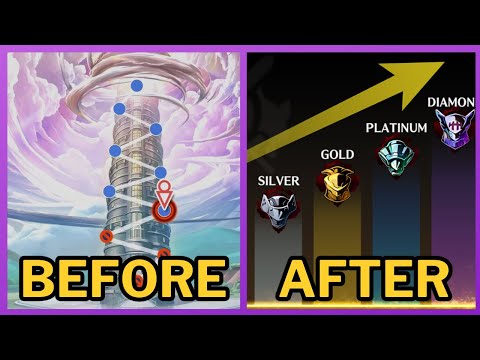
The tier order is:
| Tier | Sub-tiers |
|---|---|
| Iron | 1–3 |
| Bronze | 1–3 |
| Silver | 1–3 |
| Gold | 1–3 |
| Platinum | 1–3 |
| Diamond | 1–3 |
| Vanquisher | (see below) |
This is the ladder that actually measures competitive skill in 2026. If someone asks “what rank are you,” the honest answer now usually means your Ranked Match tier, not your floor.
The top end: Vanquisher, Duel Rating, and Imperius
Once you reach Vanquisher, two things change. You can no longer be demoted below it, and your matches start counting toward Duel Rating (DR): a seasonal skill number that decides the very top of the ladder.
DR runs in seasonal Phases that turn over roughly every three months. Originally each Phase reset DR to a flat 1500, but Version 2.00 (April 9, 2026) changed this to a soft reset based on your previous Phase’s final DR: finish a Phase high and you restart a bit above the pack, finish low and you restart nearer the middle, per the official Ver. 2.00 patch notes. As of June 2026, Ranked Match is in Phase 4, which began June 1, 2026 and was the first to use the soft reset. Check the latest patch notes for the current Phase.
Version 2.00 also added DR-based levels inside Vanquisher:
| Level | DR range |
|---|---|
| Vanquisher | below 1600 |
| Vanquisher I “Ignis” | 1600–1699 |
| Vanquisher II “Virtus” | 1700–1799 |
| Vanquisher III “Vindex” | 1800+ |
Above all of that sits Imperius: a title shown only for the top 100 ranked Vanquisher players per character. It overrides the level display and shows your exact placement number. It is the genuine elite of Guilty Gear Strive ranking.
Guilty Gear Strive ranks: Tower vs Ranked Match
Quick guidance:
- Want a casual, social climb with floor-mates of similar skill? Play the Duel Tower and chase Celestial.
- Want the real competitive measure and a number that tracks your skill tightly? Play Ranked Match and push for Vanquisher and DR.
Many players do both: the Tower for relaxed sets, Ranked Match when they want to prove something. Neither is “wrong,” but only Ranked Match’s DR is built to be a precise skill rating.
Where most players sit
Arc System Works does not publish an official rank-distribution dashboard, so anyone quoting exact percentages is guessing. What is safe to say is the shape: the bulk of the playerbase clusters in the middle floors of the Tower (roughly the mid-single-digit floors) and in the Silver-to-Platinum band of Ranked Match. Celestial and the upper Vanquisher levels are genuinely rare by design, and Imperius is literally capped at the top 100 per character.
Quick FAQ
- How do I rank up fast? Beat players above you. The Tower’s hidden Rating Update and Ranked Match’s RP both reward wins against stronger opponents far more than farming weaker ones.
- Can I derank? Yes, to a point. In the Tower you can drop floors, and in Ranked Match you can lose RP and tiers, but you cannot fall below Vanquisher once you reach it.
- Does my rank reset monthly? The Tower’s monthly reset no longer demotes you out of Celestial. Ranked Match’s DR resets each ~3-month Phase, now via a soft reset (Version 2.00) rather than a hard wipe to 1500.
- Is rank per character or per account? Ranked Match is per character. The Tower assigns you a single floor.
Want to keep reading? If you are picking a main to climb with, see our Guilty Gear Strive tier list. For how a different competitive ladder handles tiers and points, compare Street Fighter 6 ranks explained. And if you want friends along for the climb, here is whether Guilty Gear Strive has crossplay.
Sources
- GUILTY GEAR -STRIVE- Ver. 1.48 patch notes (Arc System Works): official addition of Ranked Match and the Duel Tower / Celestial Floor changes (Celestial Challenge removed, no more monthly demotion).
- GUILTY GEAR -STRIVE- Ver. 2.00 patch notes (Arc System Works): official DR-based Vanquisher levels (Ignis/Virtus/Vindex), the Imperius top-100 title, and the Duel Rating soft reset.
- GUILTY GEAR -STRIVE- official Online guide (Arc System Works): official overview of the online modes and the Duel Tower floor structure.
- Duel Tower — The Guilty Gear Wiki: community reference for the floor ladder, Rating Updates, and the removed Celestial Challenge.
- Ranked Match — The Guilty Gear Wiki: community reference for the per-character tier ladder, placement matches, RP, and Duel Rating.
- Guilty Gear -Strive- Wiki (Dustloop): community hub for frame data, character guides, and game systems.
- EventHubs: Guilty Gear Strive’s tower system could revolutionize ranking (2021): early coverage of the Floor/tower design and the Floor 10-to-Celestial skill gap.
- EventHubs: Celestial rank rewards — the red avatar aura (2021): first reporting on the red aura and other Celestial cosmetic rewards.